

Secure Document management for legal firms is the process of storing, organising, securing, and retrieving legal documents digitally. The right system should ensure security, compliance, quick access, and audit readiness while reducing manual effort and storage costs.
Introduction
Every day, law firms in India handle huge amounts of case files, contracts, affidavits, and compliance paperwork. It takes a long time, is risky, and costs a lot of money to manage these records by hand. At this point, document management for law firms becomes very important.
Studies suggest that professionals spend up to 30 to 40 per cent of their time searching for information. In legal environments, this delay can directly impact case outcomes and client satisfaction.
The challenge is not just storage. It is about compliance, confidentiality, and control. Missing documents, delayed retrieval, and audit gaps can expose firms to serious risks.
This is why digitisation is no longer an operational upgrade. It is a strategic decision. Choosing the right document management software can transform how legal firms in India operate, collaborate, and scale.
Why do legal firms in India need secure document management now?
Legal firms need secure document systems to handle growing data volumes, meet compliance requirements, support remote work, and reduce risks like data loss or unauthorised access.
Key reasons:
- Increasing regulatory pressure in India
- Rising case documentation volume
- Remote and hybrid legal teams
- Need for faster case preparation
- Risk of data breaches and document loss
In simple terms, paper-based systems cannot keep up anymore.
What features should a legal document management system have?
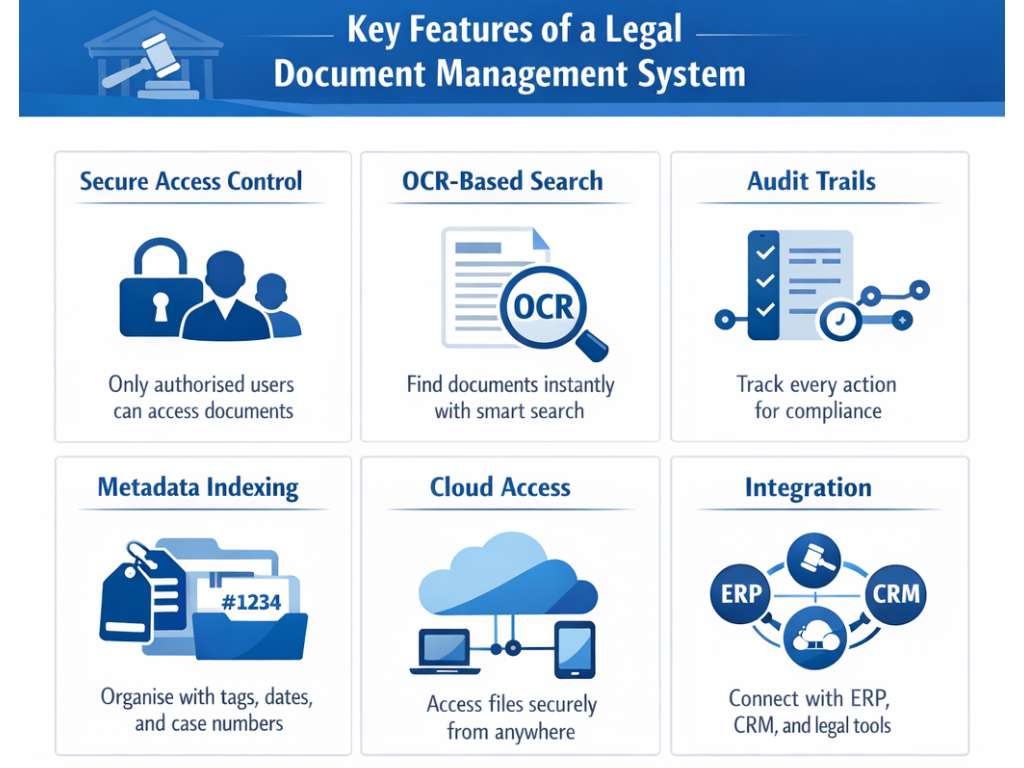
A legal document system should include secure storage, access control, OCR search, audit logs, and integration with existing workflows.
Must-have features:
1. Secure access control
Only authorised users can access specific documents.
This protects confidential legal data.
2. OCR-based searchability
Using OCR technology, documents become searchable.
This reduces retrieval time from hours to seconds.
3. Audit trails
Every action is recorded.
This helps during compliance checks in India.
4. Metadata indexing
Documents are tagged using keywords, case numbers, and dates.
This improves organisation and retrieval.
5. Cloud-based access
Access files securely from anywhere.
Useful for distributed legal teams.
6. Integration capabilities
Works with ERP, CRM, or legal software.
This ensures workflow continuity.
Want to see how secure legal document systems work in practice?
How does the document management process work in legal firms?
The document management process involves scanning, indexing, storing, securing, and retrieving documents through a structured digital workflow.
Step-by-step process:
- Document collection
Physical files are gathered and organised. - Preparation
Staples removed, documents sorted. - Scanning and digitisation
High-end scanners convert files into digital format. - OCR processing
Text is extracted for searchability. - Indexing and tagging
Metadata added for easy retrieval. - Storage in cloud DMS
Stored securely with encryption. - Access and retrieval
Users access documents based on permissions.
This structured approach ensures accuracy, security, and efficiency.
What are the risks of poor document management methods?
Poor document management methods lead to data loss, compliance failures, inefficiency, and increased operational costs.
Common risks:
- Lost or misplaced legal files
- Delayed case preparation
- Compliance violations in India
- High physical storage costs
- Data breaches and unauthorised access
- Inefficient manual workflows
A single missing document can impact an entire case.
How to evaluate document management tools for your firm?
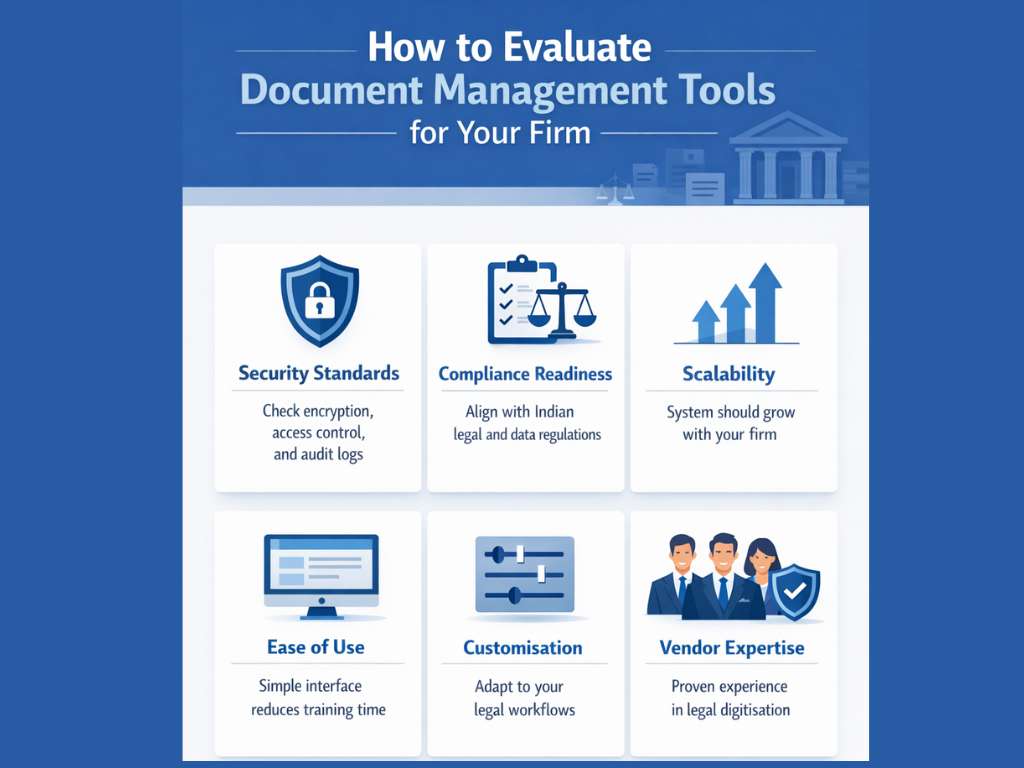
Evaluate document management tools based on security, scalability, compliance support, and ease of use.
Key evaluation criteria:
1. Security standards
Check encryption, access control, and audit logs.
2. Compliance readiness
Ensure alignment with Indian legal and data regulations.
3. Scalability
System should grow with your firm.
4. Ease of use
Simple interface reduces training time.
5. Customisation
Ability to adapt to legal workflows.
6. Vendor expertise
Experience in legal digitisation matters.
Not sure which solution fits your legal practice?
What is the role of compliance and data security in India?
Compliance ensures legal data is stored, accessed, and managed according to regulations, while security protects it from breaches.
In India, legal firms must ensure:
- Confidentiality of client data
- Proper record retention
- Audit readiness
- Secure document handling
Key security elements:
- Data encryption
- Chain of custody
- Role-based access
- Secure cloud storage
- Regular audits
This is not optional. It is essential for credibility.
How does SKYSITE INDIA enable the digitisation of legal documents?
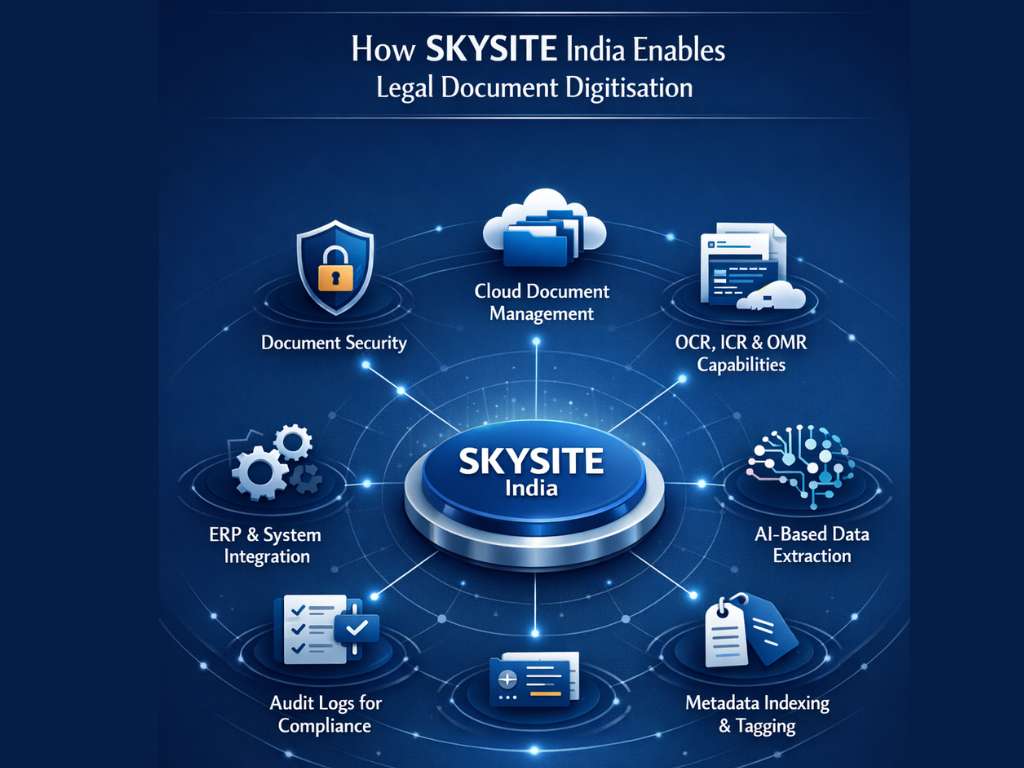
The primary features of SKYSITE India include:
- Document Security
- Cloud Software for Document Management
- Advanced Optical Character Recognition, Intelligent Character Recognition, and Optical Mark Recognition capabilities
- Artificial Intelligence Based Data Extraction
- Indexing and Tagging of Documents using Metadata.
- Audit Logs for Compliance Tracking
- Integration with Enterprise Resource Planning and Other Systems.
Examples of How This Helps Legal Firms
- Retrieval of Information/Cases quicker than currently possible
- Significant Reduction in the Amount of Time and Effort needed to Store Documents
- Improved Ability to Comply with Regulations
- Streamlined Case Managed and Their Files
- Reduced Costs for Storing Documents
Explore how SKYSITE INDIA can digitise your legal records securely and efficiently.
How can legal firms overcome objections to digitisation?
Most concerns can be addressed with proper planning, security assurance, and phased implementation.
Common concerns and solutions:
- Cost concerns
Digital systems reduce long-term storage and operational costs. - Data security doubts
Encryption and access control ensure safety. - Workflow disruption
Phased implementation avoids major disruption. - Internal resistance
Training and ease of use improve adoption.
In simple terms, the benefits outweigh the risks.
Final checklist before choosing a document management system
Use this checklist:
- Does it support document management for legal firms?
- Is it compliant with regulations in India?
- Does it include OCR and indexing?
- Is the data secure and encrypted?
- Can it scale with your firm?
- Does it integrate with existing systems?
- Is support available when needed?
If the answer is yes to all, you are on the right track.
Ready to modernise your legal document workflows?
FAQs: Secure Document Management for Legal Firms in India
What is Document Management for Attorneys?
Essentially, document management refers to the storage, organisation, security and retrieval of legal documents digitally. Document management enables law offices to manage case files, contracts and records effectively while still maintaining confidentiality and compliance.
Why is secure Document Management Critical for law practices in India?
Secure Document Management is vital because Law Firms have access to highly sensitive data regarding their clients. In India, Document Management will help with the prevention of data losses, maintaining compliance, as well as enabling attorneys to access critical documents when needed during audits and preparing for court.
List the primary elements of a legal Document Management System.
A legal Document Management System should provide secure access control, OCR-based searchability, audit trails, indexing via metadata, Cloud storage; and system integration. Each of these elements provides law firms with the ability to work more efficiently, store documents more securely, and retrieve documents more easily.
What does the Document Management process entail for law practices?
The Document Management process includes the collection, scanning, and processing of documents as well as OCRing them, indexing them, storing them securely, and retrieving them from storage; thereby creating a structured flow of information that will make it easy for law firms to locate, secure and provide Audit-ready documents.
What are the best systems for managing documents in the legal field?
The best systems for managing documents provide secure access through cloud technology, multi-layer Security and OCR functionality, and integrate into your workflow. The best system for you depends on your size, amount of documents stored, and compliance requirements in India.
How does OCR (Optical Character Recognition) help with document management in Legal Firms?
OCR takes scanned documents and turns them into a searchable text. This will allow legal departments to search for specific information without having to go through the entire file. This will help save time and increase productivity for the legal department.
Is Cloud Based Document Management Safe for Legal Firms?
Yes! Cloud-Based Document Management Systems (DMS) uses encryption, access controls, and audit logs to keep your information safe. When properly set up, it provides more security to your documents than physical storage.
What Risk is There By Not Using A Document Management System?
Firms are at risk for losing documents, having their documents retrieved late, lacking compliance with state and federal laws, having higher costs to store documents, and having their information breached. Each of these problems could hurt a firm’s legal practice or the client’s trust in them.
What methods do law firms in India use to comply with their document management systems?
The methods law firms in compliance with their document management systems are by having systems that maintain an audit log of every document; have a secure storage solution; have access controls to protect documents; and, have reasonable document retention policies that are consistent with regulatory requirements for law firms in India.
What criteria do you use to select document management software for a law firm?
When selecting a DMS, be sure to consider security features, compliance support, scalability, usability, and capability for integration with other business software, while ensuring the DMS meets your firm’s workflow and document management processes.