
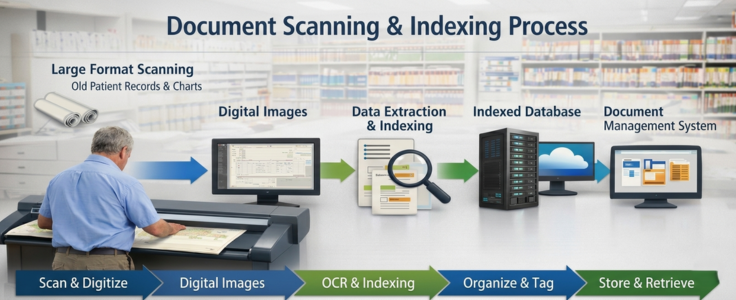
Healthcare organizations in India improve compliance and efficiency through secure document scanning by converting paper records into protected digital files. This reduces document loss, speeds up retrieval, supports regulatory audits, and lowers storage costs while keeping sensitive patient information secure.
Introduction
Thousands of sensitive patient records are created and processed by healthcare organizations throughout India every single day. Physical records remain an integral component in the operations of hospitals, diagnostic laboratories, clinics, and insurance companies in India, and as a result, lengthy processing timelines, lost and misfiled records, and increased potential for compliance-related violations have become commonplace.
Healthcare organizations are using specific technological equipment for the digitization of the paper file into structured, digital filing systems within their business, while ensuring that patient confidential information remains protected. Many healthcare organizations are also now utilizing an external service or company that specializes in electronically managing patient files, consent forms, insurance claims, and diagnostic reports on behalf of the healthcare organizations themselves.
The continued rapid growth of the healthcare sector means that industry experts expect the total size of the healthcare sector in India to be larger than USD 370 billion in a very few years.
As this growth occurs, hospital administration will face continued increases in their patient data volume, continued regulatory oversight, and an increased complexity in the way their organizations operate.
Healthcare organizations cannot provide high-quality patient care to the increasing volume of patients simply by using their current paper-based systems. Hospital administrators and compliance officers will continue to experience significant operational stress due to lost patient files, late audits of financial records, and increasing costs associated with the storage of patient medical records.
Digitization of healthcare records is no longer simply a means of improving administrative functions; it is now a strategic initiative for managing compliance, increasing efficiency, and minimizing risk.
What Is the Real Challenge Facing Healthcare in India?
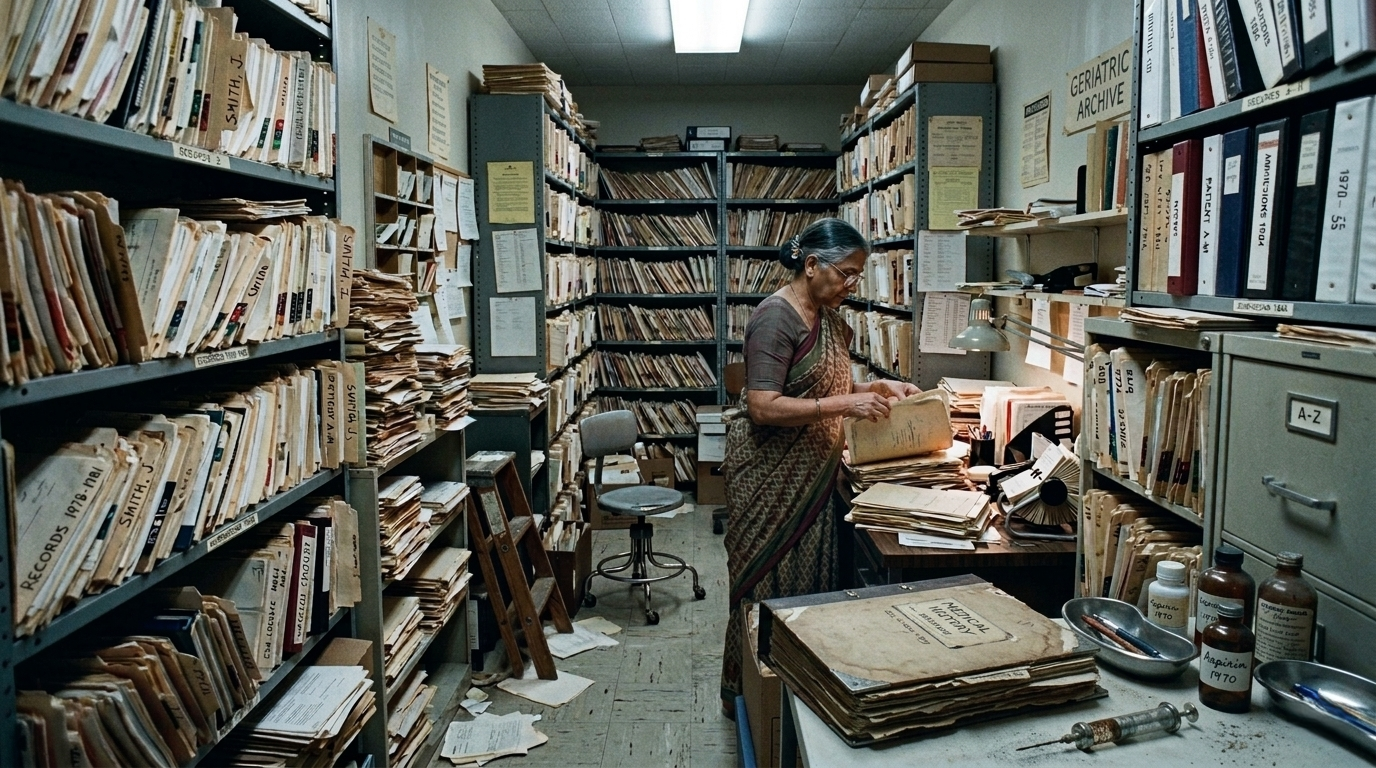
The Indian healthcare system must deal with operational complexities due to the sheer number of patients served and the requirements to maintain complete documentation. Thus, the challenge becomes managing sensitive patient records while ensuring efficiency in functioning and meeting strict compliance levels.
Within a given facility, there are numerous types of documentation, including:
- Patient admission form
- Insurance documentation
- Medical records
- Diagnostic records
- Vendor contracts
- Compliance documentation
Despite advances in technology, many healthcare providers still use physical recordkeeping systems or partly digitised systems. Both conditions increase the risks of document loss and the time needed to retrieve documents. Although numerous healthcare facilities use secure archiving solutions to manage records, the lack of proper digitization leads to continuing problems.
Use of paper records includes:
1 – Operational inefficiencies
2 – Compliance exposures
3 – Expensive storage
4 – Delayed audits
5 – No automation of processes
All patient data should be protected as confidential data, so hospitals must have a confidential document scanning process to digitise paper records. Some hospitals will use on-site confidential scanning to ensure that sensitive documents never leave the building during scanning. For larger archiving projects, some healthcare organizations utilize off-site service providers to load their materials into secure environments.
To summarize, healthcare organizations with increased patient volume and associated growth in documents must find solutions for managing the additional volume of data while satisfying patient privacy.
Why Is Traditional Document Management Failing Modern Healthcare?
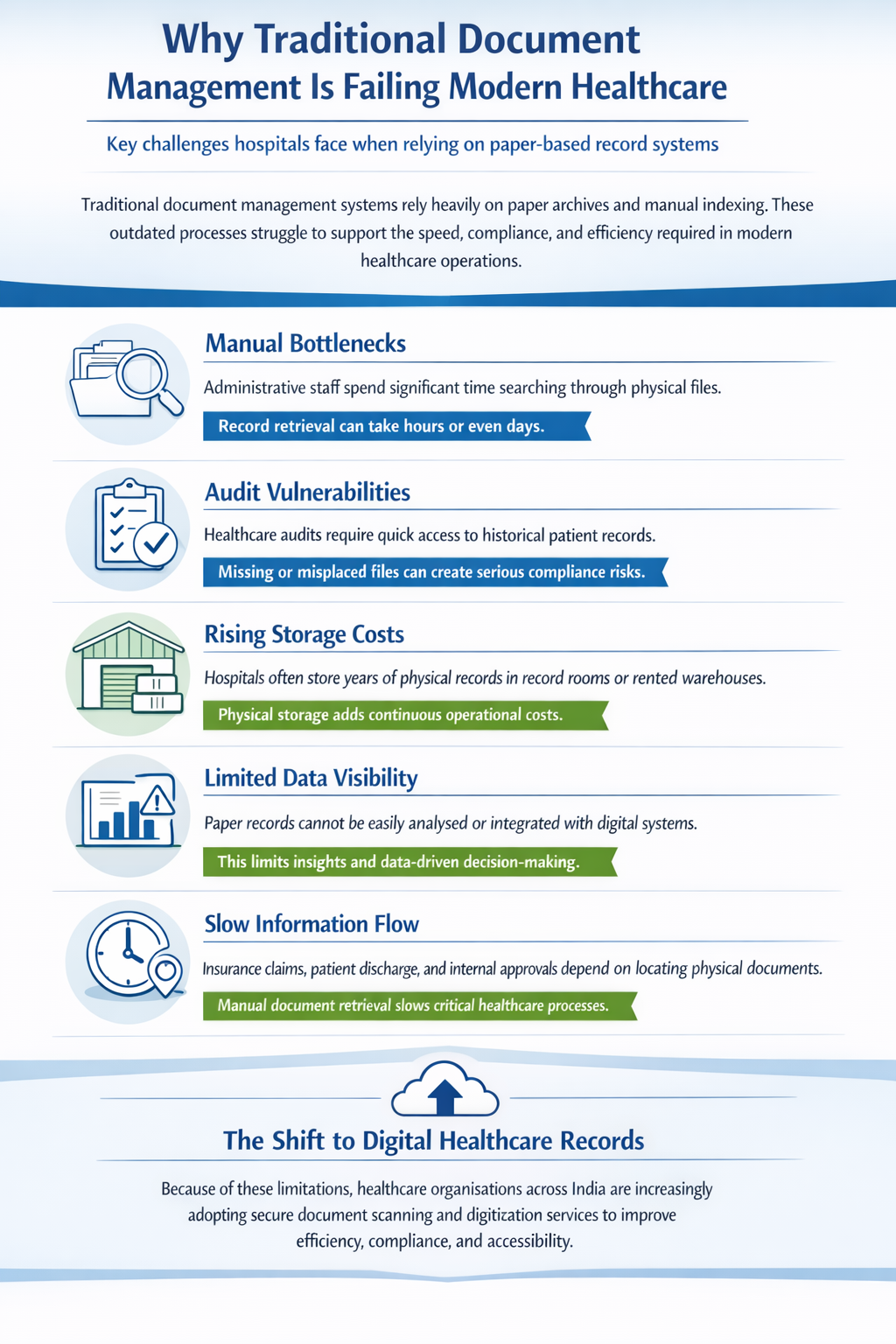
Traditional document management systems, which support the use of a paper-based filing system for archiving documents, are being challenged by the increasing complexities of modern healthcare operations. In many cases, it doesn’t provide the needed support for today’s healthcare market.
The reasons why many healthcare organizations have been moving from traditional document management systems to digital document systems are as follows:
Manual Bottlenecks
Bottlenecks with people manually searching for documents in file cabinets, drawers, and other physical locations take time – often hours or days to locate/correlate all of the required documents.
Audit Vulnerabilities
Issues during the audit process when accessing historical records, a shortage of historical or current files being brought into compliance, or not having proper documentation to prove compliance.
Rising Storage Costs
Cost for storing documents; many healthcare organizations store many years of documentation in rented warehouse facilities or rooms.
Limited Data Visibility
Lack of document visibility with paper-based systems makes it harder for staff to correlate/use/and review various documents, especially when the staff are not based in the same location.
Slow Information Flow
Delay in processing of information for insurance claim and patient discharge process; lack of timely document location and verification causes delays in finalizing patient discharge or processing insurance claim.
Healthcare organizations in India are transitioning away from caring for patients through traditional document management systems and moving to document scanning services that provide healthcare organizations with timely access to all records while maintaining confidentiality for all records.
How Does Secure Document Scanning Transform Healthcare Operations?
Secure document scanning is the process of converting paper records into structured digital files using controlled and secure workflows.
This means documents are scanned, indexed, stored securely, and made searchable.
What Is Document Digitization?
Document digitization converts physical files into digital formats that can be stored, searched, and shared electronically.
What Is OCR?
OCR, or Optical Character Recognition, converts printed text into machine-readable text.
What Is Metadata Indexing?
Metadata indexing assigns identifiers such as patient ID, hospital department, or document type to each file.
These technologies work together to create a searchable digital archive.
Technologies Used
Modern digitization uses several technologies:
- OCR for text recognition
- ICR for handwritten data capture
- OMR for form processing
- AI extraction for structured data
- Cloud DMS for document storage
- ERP integration for workflow connectivity
- Metadata indexing for faster search
- Audit logs for compliance tracking
SKYSITE Capabilities
SKYSITE support healthcare organizations through: Document scanning, Bulk document scanning, Secured document scanning, Indexing and classification, Integration with hospital systems.
Organizations can choose on-site confidential scanning when dealing with sensitive patient records. For large historical archives, a secure off-site scanning service may be used.
Once digitized, files become easier to manage and retrieve.
Why Are Compliance and Security Important for Healthcare in India?
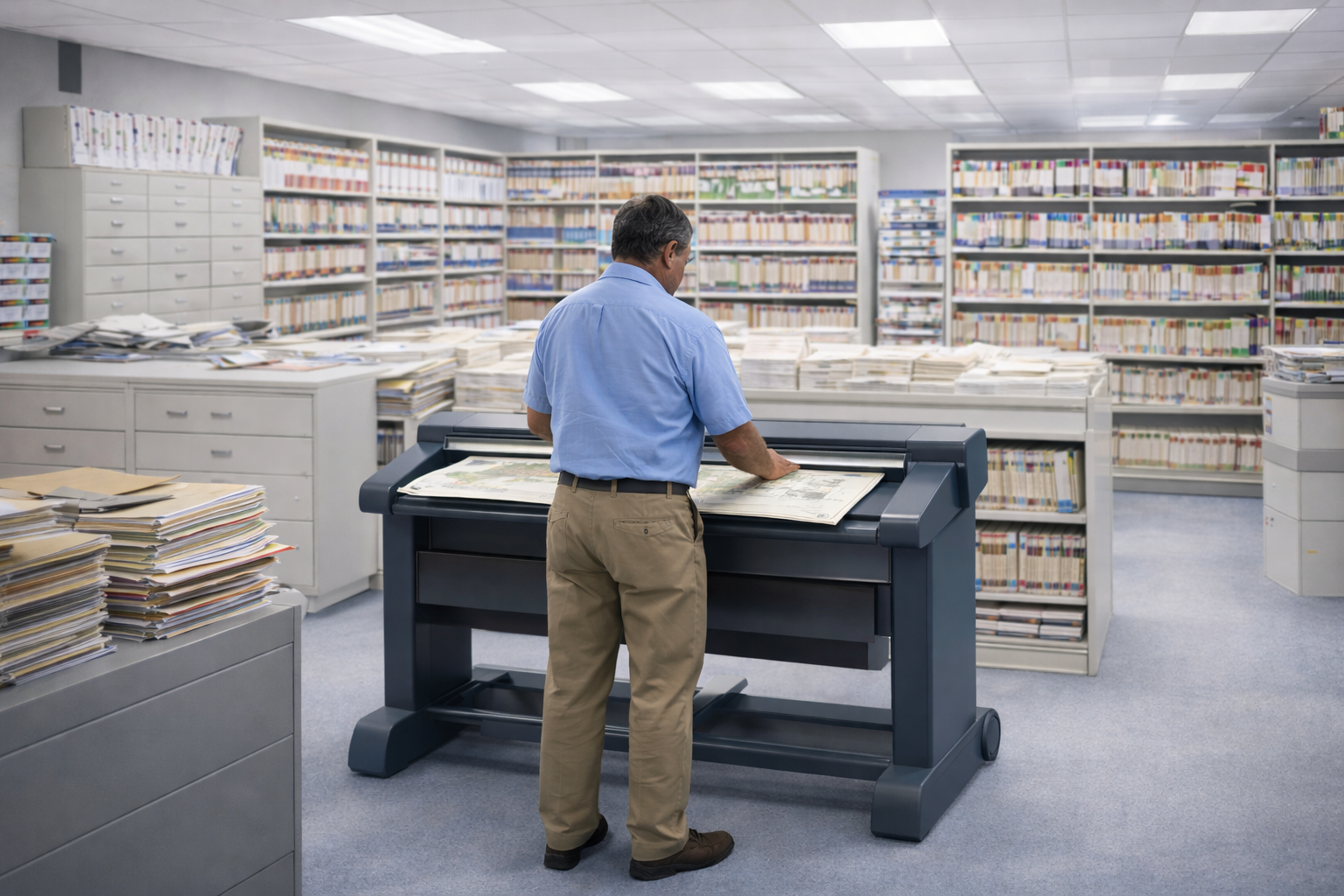
Healthcare records contain sensitive patient information. Protecting this information is both an ethical responsibility and a regulatory requirement.
Healthcare organizations in India must follow several compliance frameworks, such as:
- NABH accreditation requirements
- Information Technology Act provisions
- Data protection guidelines
- Medical record retention policies
Proper document management helps organizations meet these requirements.
Secure document scanning services support compliance through:
- Controlled document handling
- Encrypted digital storage
- Access control systems
- Audit logs for document access
These measures ensure patient data remains protected.
Healthcare administrators often worry about data security when outsourcing scanning projects. This concern is valid.
Professional digitization providers address these concerns through strict security protocols and monitored workflows.
In India, compliance expectations are increasing due to regulatory oversight and digital health initiatives.
Digitization allows healthcare organizations to maintain secure and organized records that support long-term governance.
What Is the Operational ROI for Healthcare Organizations?
Digitization provides measurable operational benefits for healthcare organizations in India.
Cost Reduction
Hospitals reduce expenses related to physical storage and document management.
Digitised records also reduce printing and copying costs.
Productivity Gains
Staff can retrieve patient records within seconds instead of searching through file cabinets.
Administrative teams spend less time managing paperwork.
Workflow Acceleration
Digitized documents integrate with hospital systems and ERP platforms.
Insurance claims, discharge processes, and internal approvals become faster.
Audit Readiness
Digital records are indexed and searchable.
This allows hospitals to prepare for audits quickly without manual file sorting.
The overall impact is improved operational efficiency and reduced administrative burden.
Real World Scenario for Healthcare Providers
Consider a mid-sized hospital in India managing more than ten years of patient records.
Problem
The hospital stored files in multiple record rooms. Retrieval often took several hours. During audits, staff struggled to locate specific documents.
Solution
The hospital implemented secure document scanning for patient files and administrative records.
Historical documents were digitised using confidential document scanning processes. Sensitive files were scanned on-site through confidential scanning to maintain security.
Outcome
After digitization, the hospital created a searchable digital archive. Records could be retrieved instantly. Storage rooms were reduced. Audit preparation became simpler and more organised.
The improvement came from structured document management rather than dramatic technology changes.
What Should You Look for in a Digitization Partner in India?
Selecting the right digitization partner is important for healthcare organizations.
Consider the following checklist.
- Experience with healthcare documentation
- Capability for secure document scanning services
- Availability of on-site confidential scanning
- Option for secure off-site scanning service for bulk projects
- Strong data protection protocols
- Integration capability with hospital ERP systems
- Clear service level agreements
- Proven secure archiving solutions
Healthcare organizations often worry about disruption during digitization.
A reliable provider follows phased implementation to minimize operational impact.
This ensures normal hospital operations continue smoothly.
Is Your Organization Ready for Digital Transformation?
Healthcare organizations in India should consider digitization when certain warning signs appear.
Common indicators include:
- Storage rooms reaching capacity
- Frequent document retrieval delays
- Rising compliance pressure
- Expansion into new healthcare facilities
- Need for remote access to records
- Increasing audit requirements
These signals suggest that traditional document systems are no longer sustainable.
Digitization allows healthcare organizations to manage information more efficiently.
If your healthcare organization in India is facing storage pressure or audit challenges, it may be time to review your document management process.
Evaluate your current workflow, identify bottlenecks, and determine whether secure document scanning services can improve efficiency and compliance.
The Strategic Shift From Paper to Intelligent Data Assets
The healthcare industry of India is experiencing an era of significant change. Volume of patients being treated is increasing, regulatory requirements are continuing to increase, and new digital health initiatives continue to be introduced at an increasing rate.
Paper-based record management is unable to support this type of increased activity in an effective manner.
Secure document scanning converts paper records to structured digital assets that can be used to improve the organization’s ability to comply with applicable laws and regulations and to assist with increasing operational efficiencies and improved governance.
When properly implemented, the digitization of paper records makes records easier for healthcare organizations to access, but it also provides additional safeguards for the protection of sensitive information.
For health leaders, moving from a paper-based archiving organization to a digital document eco-system is not only an improvement in your operations; it is also a strategic move that supports the ongoing growth of your organization and your readiness to meet future regulatory standards.
FAQ
What does ‘ Document Digitization ‘ mean in terms of the healthcare system?
Document Digitization’ refers to the process of converting paper documents stored on paper within a hospital into electronic, searchable image files through the use of scanners and data recognition software. Hospitals can use digitization technologies to store, access and manage patient records more efficiently.
How does digitization help organizations comply with regulations in India?
Continual digitization helps institutions keep accurate records and the ability to monitor who has accessed the document, and to have processes in place to ensure compliance with the retention policies imposed on healthcare documents through law.
How safe is on-site scanning?
With controlled scanning at hospitals, any scanned document will be done onsite, allowing the facilities/providers to ensure that there remains confidentiality over all scanned patient documents.
What’s a typical turnaround time for digitization?
The time required for digitizing records depends on the size of the record and the type of index used for the records themselves. A large record or document may require several weeks to digitize. However, a small number of records can normally be digitized within a few days.
What’s the ROI from document digitization?
The largest benefits associated with digitization are decreased storage costs, faster access to documents, improved readiness for an audit and increased overall efficiency of the organization.