

Hospitals in India can implement medical document digitisation safely by following a structured process that includes secure scanning, OCR-based data extraction, compliance-aligned storage, controlled access, and audit trails. This ensures patient data protection, faster retrieval, and regulatory readiness without disrupting daily operations.
Introduction
Hospitals across India are under pressure to modernise their record systems. From patient files to diagnostic reports, the volume of physical documents continues to grow. This is where medical document digitisation becomes a strategic need, not just an operational upgrade.
In simple terms, hospitals need faster access, better compliance, and lower storage costs. Yet, many still rely on paper-based systems that slow down care delivery and increase risk.
According to industry estimates, healthcare data is growing at over 20 per cent annually. For hospitals in India, this means rising storage costs and higher audit pressure.
The real concern is not just storage. It is about patient safety, data accessibility, and regulatory compliance. Digitisation addresses all three when done correctly.
What is medical document digitisation in hospitals?
Medical document digitisation means converting physical patient records into digital formats using scanning and intelligent data extraction technologies.
This includes:
- Patient case files
- Lab reports
- Insurance documents
- Consent forms
- Radiology records
The goal is simple. Make records searchable, secure, and easy to access.
Why is digitisation critical for hospitals in India?
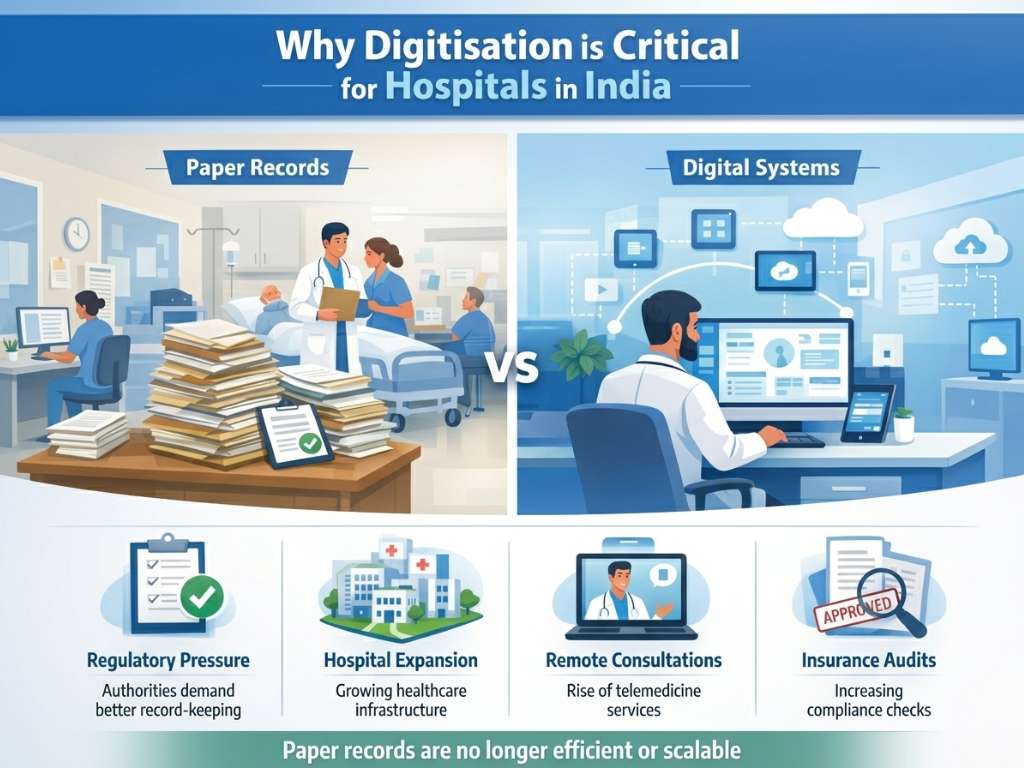
Hospitals in India operate in a high-pressure environment with strict compliance expectations.
Digitisation becomes essential due to:
- Regulatory bodies want better record-keeping.
- Hospitals are opening up in more places.
- More and more people are having remote consultations.
- There are more and more insurance audits.
This means that paper records are no longer useful.
What dangers are there in keeping records by hand?
Manual systems pose risks to operations and compliance.
Some of the most important risks are:
- Patient files that are in the wrong place
- Access is delayed during emergencies
- Errors that cause data to be copied
- High costs of physical storage
- Limited visibility for audits
This has a direct effect on how well hospitals care for patients and how well they run.
How does the medical record digitisation process work?
The medical record digitisation process follows a structured approach to ensure safety and accuracy.
Step-by-step process:
- Document Collection
Records are gathered and sorted department-wise. - Preparation
Staples removed, pages aligned, damaged files repaired. - Scanning
High-resolution scanners capture images. - Data Extraction
OCR, ICR, and AI tools extract key information. - Indexing
Metadata tagging for easy search and retrieval. - Quality Check
Verification for accuracy and completeness. - Secure Storage
Upload to cloud or integrated DMS.
This ensures a reliable and compliant system.
Want a tailored digitisation roadmap for your hospital?
Start with a quick assessment of your current document workflows.
What are the safest healthcare document scanning methods?
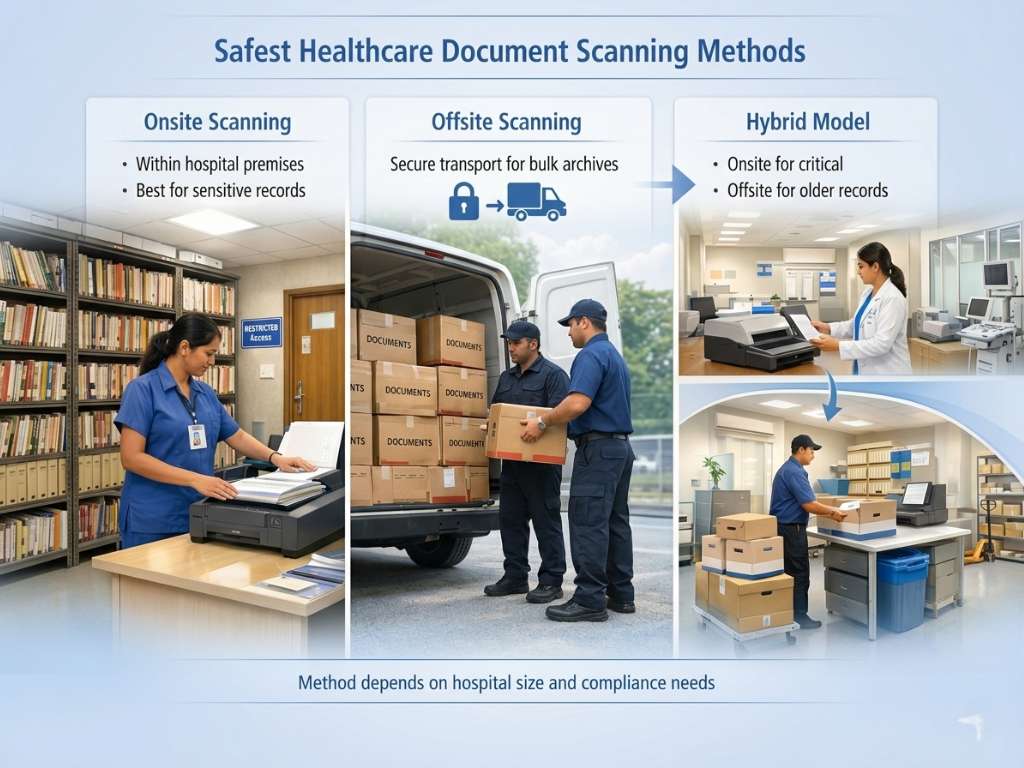
Healthcare document scanning methods must prioritise data security and accuracy.
Common methods include:
1. Onsite Scanning
Scanning happens within hospital premises.
Best for sensitive records.
2. Offsite Scanning
Documents are transported securely to a facility.
Useful for bulk archives.
3. Hybrid Model
Critical records onsite, older records offsite.
Each method depends on hospital size and compliance needs.
How to digitise medical records safely without disrupting operations?
To digitise medical records safely, hospitals must ensure minimal disruption.
Best practices include:
- Phased digitisation by department
- Night or off-peak scanning schedules
- Dedicated project teams
- Clear chain of custody
- Role-based data access
This ensures daily operations continue smoothly.
Explore how phased digitisation can reduce risk and downtime in your hospital.
What compliance requirements must hospitals in India follow?
Hospitals in India must align with data protection and healthcare regulations.
Key compliance areas include:
- Patient data confidentiality
- Secure storage and access control
- Audit logs for tracking usage
- Retention policies for medical records
Digitisation systems must support these requirements by design.
This is where secure document digitisation for hospitals becomes essential.
How does technology like OCR and AI improve digitisation?
Technology plays a major role in accuracy and efficiency.
Key technologies:
- OCR (Optical Character Recognition)
Converts scanned images into searchable text. - ICR (Intelligent Character Recognition)
Reads handwritten notes. - OMR (Optical Mark Recognition)
Captures marked fields in forms. - AI-based extraction
Identifies and organises data automatically.
This reduces manual work and improves speed.
What is the patient record digitisation workflow?
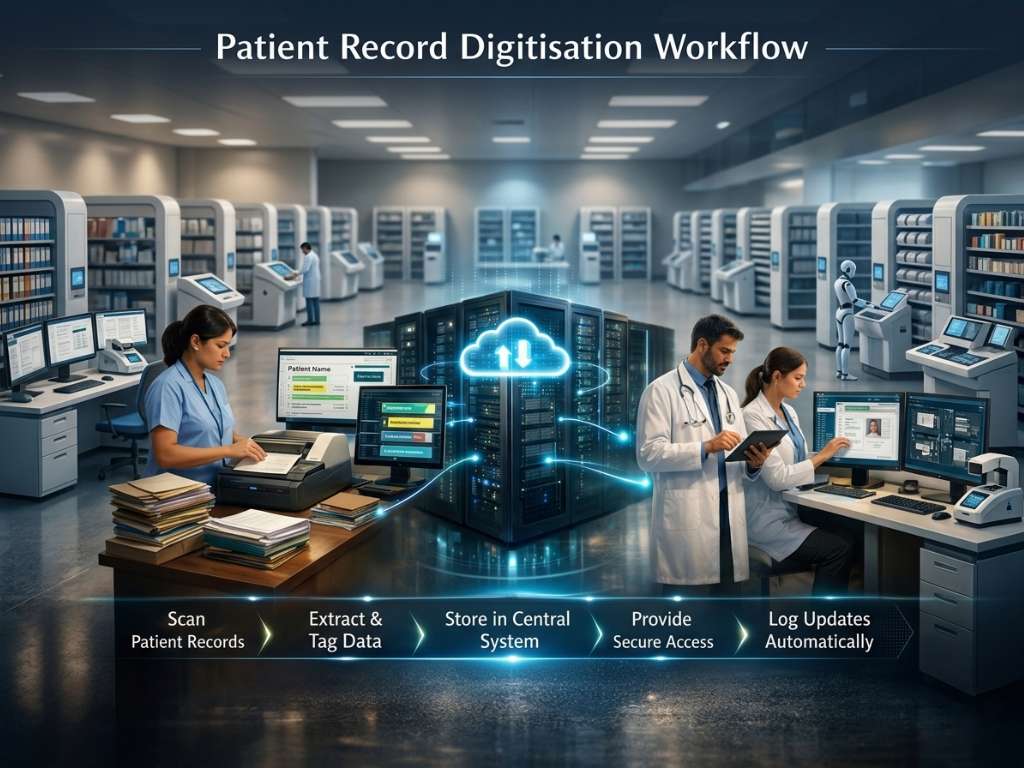
The patient record digitisation workflow defines how records move through the system.
Typical workflow:
- Patient records scanned
- Data extracted and tagged
- Stored in the central system
- Access provided to authorised staff
- Updates logged automatically
This creates a seamless and trackable system.
What are the benefits of secure document digitisation for hospitals?
Secure document digitisation for hospitals delivers both operational and strategic benefits.
Key benefits:
- Faster patient data access
- Reduced storage costs
- Improved audit readiness
- Enhanced data security
- Better coordination across departments
In simple terms, it improves both care and efficiency.
See how digitisation can reduce your hospital’s storage costs by up to 40 per cent.
What are the common objections, and how to overcome them?
Hospitals often hesitate due to practical concerns.
1. Cost concerns
Digitisation is seen as expensive.
Reality: Long-term savings outweigh initial investment.
2. Data security doubts
Fear of breaches.
Solution: Use encrypted systems with audit trails.
3. Operational disruption
Worry about workflow impact.
Solution: Phased implementation.
4. Internal resistance
Staff are reluctant to change.
Solution: Training and gradual adoption.
How to choose the right digitisation partner in India?
Choosing the right partner is critical for success.
Look for:
- Experience in healthcare projects
- Strong compliance framework
- Advanced tech capabilities like OCR and AI
- Secure infrastructure
- Integration with existing hospital systems
A reliable partner ensures smooth execution and long-term value.
Speak to a specialist to evaluate your hospital’s digitisation readiness.
Ending Note
In India, healthcare facilities can’t avoid going digital anymore. Medical records need to be digitised not just to tick off regulatory boxes, but also to make things run more smoothly and meet what patients now expect. By digitising these records, hospitals stop scrambling to keep up with paperwork. They start taking control, managing patient information better, and pulling up important data faster when it matters most.
When properly implemented, this transformation should also decrease risks associated with patient care and improve the overall quality of care provided to patients. Finally, if implemented effectively, hospitals will be positioned to grow. The starting point is to view the transition as an organised change rather than simply a process of converting paper documents to electronic formats by means of scanning them.
FAQs
What does it mean to “digitise documents” in the context of hospitals?
When looking at patient files in physical form, hospitals must tackle issues such as ordering and accessing the records with the utmost ease. When the records of the patients are digitised, the hospital is able to utilise an eHealth record, where the hospital must only manage and store the record digitally, as the document no longer exists in paper form.
In what ways would digitisation enhance the law compliance of hospitals in India?
With the law compliance, hospitals would need to have audit trails, secured access control, and with the storage of documents being organised, hospitals would meet compliance to avoid penalties with regulations and compliance in audit situations.
Is it safe to do on-site scanning when digitising sensitive documents?
It is safe to do this on-site scanning for the reasons that the hospital keeps sensitive patient documents contained on the hospital grounds.
How long does digitising documents take?
The complexity of the documents and the number of documents will determine the timeline for the digitisation. Smaller hospitals will take days to complete projects, while larger hospitals will take months to digitise years of documents.
How does an organisation measure the return on investment associated with document digitisation?
Basically, ROI is calculated from the cost savings associated with reductions in the costs of paper (storage & retrieval) and the creation of more efficient processes (fewer errors and increased compliance). Most organisations will see long-term savings and operational efficiencies from their investment in document digitisation.