

Now and then, healthcare workers across India find it easier to stay within legal boundaries through secure digital filing lasting as long as needed. Because files remain available without delay and meet required timelines, physical copies exist only when already shredded – gone for good. Slowly, these habits add up: smoother daily operations, fewer hiccups in patient care or office routines. Safety grows where consistency takes root with the document shredding process and scanning.
Introduction
India’s growing healthcare sector handles immense amounts of patient data across multiple hands every day. This includes registration desks, diagnostic laboratories, insurance claims processing, administration, and more. Regulatory agencies such as the National Health Authority require healthcare organizations to take steps to protect patient data from being accessed or shared unlawfully. If a healthcare organization does not comply with these requirements, it may face significant reputational loss, financial penalties, and damage to its trustworthiness.
Despite the widespread adoption of digital technologies, there are still many healthcare organization that rely on paper documents. Many studies have shown that a large number of data exposure incidents result from the improper disposal of paper records. This is where document shredding becomes more than just a form of waste; it becomes part of a strategy to safeguard the organization’s data and its compliance with the various laws and regulations that govern it.
Professional document shredding services help hospitals and clinics to ensure that their confidential data is permanently destroyed, thereby indicating compliance with HIPAA and other applicable regulations. Combined with document scanning services and document digitization services, healthcare organizations can develop a secure, efficient and effective records management process, including the use of the proper file folder for documents and the use of certified document shredding services.
While data protection is related to the storing of records safely and securely, it is also equally important to destroy records in a responsible manner.
What Is the Real Document Risk Facing Healthcare in India?
Healthcare operations in India are expanding at an unprecedented pace. New hospitals are opening. Existing facilities are scaling. Specialized care centres are emerging across metros and tier-two cities. Every expansion brings a parallel surge in documentation.
Despite advances in health technology, paper remains deeply embedded in daily hospital functions. Patient registration forms. Insurance documents. Diagnostic reports. Consent records. Billing files. Compliance registers. Paper continues to move through departments, often across multiple touchpoints.
Healthcare records contain highly sensitive personal and medical data. Paper-based systems remain common across India. Paper documents are easily misplaced. Physical access is difficult to monitor. Retention rules vary by record category.
Improper disposal introduces a serious exposure cause. Audit challenges increase when records lack traceability. Document scanning services are now important for each sector, can secure your important paper files that are kept for long-term uses and can convert them into searchable digital records. They reduce loss. They simplify compliance verification during audits.
Why Is Traditional Record Storage Failing Modern Hospitals?
Manual storage models struggle with growing document volumes. Physical retrieval consumes staff time. Storage infrastructure costs keep rising. Misfiled records interrupt workflows.
Security gaps are harder to detect. Access to paper files is rarely logged. Loss incidents often surface late.
Many organizations invest in cabinets and the best file folders for documents, yet retrieval delays and governance limitations persist. Physical organization cannot deliver digital searchability or audit trails. Paper files track records are too tough to maintain and the process becomes slower. Sensitive information becomes a tiring process to monitor.
So, piling of papers can be secured with the best process, with the help of document scanning services. The practice of disposal becomes tricky; most of the papers are quite hard to maintain, so departments choose a reliable partner to get their job done. Document shredding is also a part of it; it plays an important role as well.
Digital records resolve many of these structural inefficiencies.
What Is Document Shredding and How Does It Work?
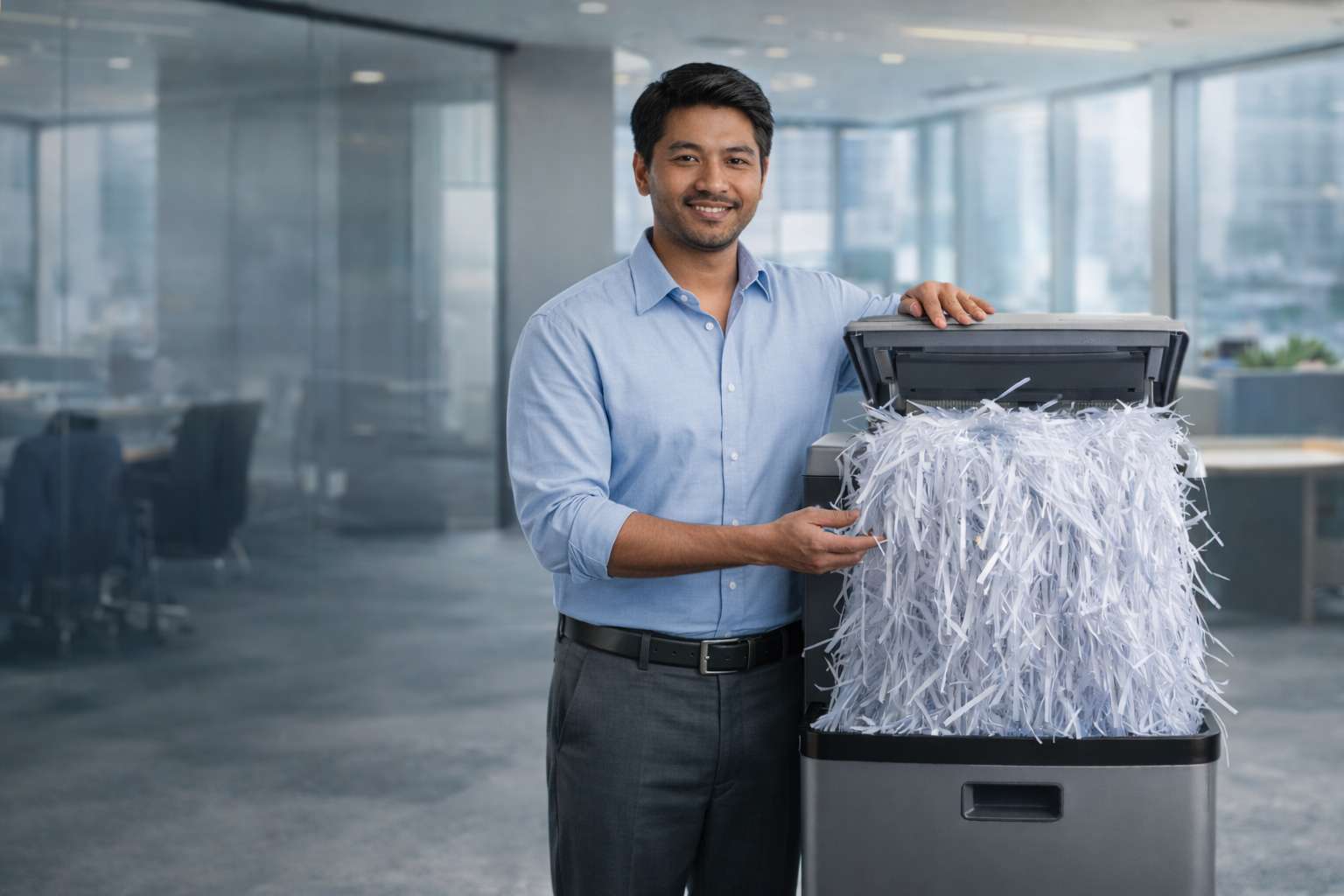
Document shredding is a major process where we can see that after the papers are secured or stored, then it’s been destroyed for betterment.
There are set steps for secure destruction:
- Records that can be destroyed are found.
- Retention requirements are validated.
- Documents are logged and secured.
- Chain of custody is established.
- Paper is destroyed using secure processes.
- Audit documentation is generated.
Two operational approaches are widely used:
- Onsite destruction
Shredding occurs within the facility.
Transport risks are eliminated. - Offsite destruction
Documents are securely transferred.
Destruction follows documented controls.
Both models demand process discipline. Both require verifiable evidence for compliance reviews.
How Does Intelligent Digitization Complement Document Shredding?
Failure to digitise before shredding could lead to irreversible loss of information. Records retained by healthcare providers cannot be destroyed regardless of their clinical, legal, or operational value. Through our document digitization service, information is preserved before physical destruction. They transform paper records into structured digital assets that are easy to search and manage.
Document scanning services enable this transition.
Critical technologies include:
- OCR (Optical Character Recognition)
Converts printed text into machine-readable data. - ICR (Intelligent Character Recognition)
Captures handwritten entries. - OMR (Optical Mark Recognition)
Extracts marked data from forms. - AI data extraction
Identifies important fields automatically. - Metadata indexing
Enhances searchability. - ERP integration
Connects records to operational systems. - Cloud DMS
Centralizes document access. - Audit logs
Track document interactions.
Digitization protects information value. Shredding protects confidentiality. Together, they establish lifecycle control.
What Are the Compliance Requirements for Healthcare in India?
Healthcare institutions in India operate under evolving privacy, retention, and governance expectations. Patient confidentiality is mandatory. Record retention practices must be defensible. Disposal activities must withstand audit scrutiny.
Compliance pressure typically arises from:
- Confidentiality obligations.
- Retention norms for medical records.
- Data protection expectations.
- Audit documentation standards.
- Secure disposal requirements.
Healthcare leaders often raise valid concerns about data security. Outsourcing fears are common. Internal stakeholders worry about control loss.
Secure document shredding services mitigate disposal risk. Digitized records with audit logs improve traceability. Access controls strengthen governance. Documented processes provide compliance confidence.
Regulatory alignment depends on procedural evidence, not verbal assurances.
What Is the Operational ROI of Secure Document Shredding?
Cost Reduction
Paper storage consumes valuable real estate within hospitals. Expansion requires additional infrastructure. Legacy records accumulate rapidly.
Secure destruction reduces redundant paper volumes. Digitization slows future storage growth.
Savings emerge from reduced space utilization and lower manual handling overheads.
Productivity Gains
Manual file retrieval interrupts staff productivity. Administrative delays increase. Clinical workflows experience friction.
Digitized records enable rapid search and instant access.
Time savings improve operational efficiency without requiring additional headcount.
Workflow Acceleration
Paper-driven movement of documents slows coordination between departments. Approval cycles lengthen. Dependencies multiply.
Digital records move seamlessly across integrated systems.
Process velocity improves. Bottlenecks reduce.
Audit Readiness
Audit preparation often becomes stressful when records are dispersed across physical storage. Missing files create uncertainty.
Indexed digital repositories simplify audit responses.
Audit logs provide verifiable document history.
Compliance reviews become less disruptive.
Real World Scenario – How a Hospital Reduced Risk
Problem
A growing hospital group in India faced document congestion. The storage rooms were saturated. Retrieval delays affected billing cycles. Audit preparation required intensive manual effort.
Solution
Inactive records were assessed against retention rules. Relevant documents were scanned using OCR and metadata indexing. Essential information was preserved digitally.
Residual paper followed secure document shredding supported by chain-of-custody controls and audit documentation.
Outcome
Storage pressure reduced. Retrieval times improved. Audit preparation became more predictable. Operational disruptions declined. Compliance confidence strengthened.
This pattern reflects a familiar transition across India’s expanding healthcare ecosystem.
What Should You Look for in a Document Shredding Partner in India?

Partner selection directly influences compliance, integrity and operational continuity.
Evaluation checklist
- Documented security protocols.
- Reliable chain of custody mechanisms.
- On-site and off-site destruction options.
- Secure destruction processes.
- Compliance framework alignment.
- Audit documentation capability.
- Integration readiness with Cloud DMS.
- Healthcare sector familiarity.
- Clear SLA definitions.
Addressing common objections
- Cost concerns
Inefficient storage and compliance failures are more expensive long-term. - Data security doubts
Certified processes and audit trails reduce exposure. - Fear of disruption
Phased transitions limit operational impact. - Internal resistance
Structured onboarding eases adoption.
Effective partnerships reduce risk while maintaining workflow stability.
Is Your Healthcare Organization Ready for Digital Transformation?
Certain warning signals indicate rising document management strain:
- Rapidly filling storage areas.
- Increasing audit frequency.
- Hospital expansion initiatives.
- Heavy reliance on manual workflows.
- Slow record retrieval cycles.
- Difficulty enabling remote access.
- Rising administrative overheads.
Digitization improves accessibility and control. Secure destruction improves compliance discipline.
Together, they enhance resilience within India’s dynamic healthcare environment.
The Strategic Shift From Paper Records to Intelligent Data Assets
Healthcare documentation across India will continue to grow alongside sector expansion. Patient volumes are rising. Care delivery models are diversifying. Compliance oversight is strengthening.
Paper-heavy systems struggle under these pressures. Storage growth alone cannot solve retrieval delays or information security gaps. Manual workflows introduce preventable inefficiencies.
Document digitization services convert static records into structured digital assets. Metadata indexing improves discoverability. Audit logs enhance accountability. ERP integration strengthens operational alignment.
Secure document shredding services close the lifecycle loop. They ensure confidential paper does not become a liability. They generate verifiable destruction evidence. They reinforce governance frameworks.
The shift is fundamentally strategic. It is about managing information systematically. It is about reducing compliance exposure. It is about enabling faster decision-making.
Healthcare leaders in India increasingly recognize that records are not passive files. They are operational resources. Well-governed information supports continuity, accuracy, and regulatory confidence.
A structured roadmap often includes:
- Document lifecycle assessment.
- Retention rule definition.
- Digitization prioritization.
- Secure storage implementation.
- Controlled destruction execution.
- Continuous audit documentation.
The approach strengthens the entire compliance posture while delivering operational value.
FAQ
What is document digitization for healthcare?
In healthcare, document digitization is the act of converting physical documents (such as medical and administrative files) into a structured digital format. digitization allows for easier access and control of documents, and it reduces the need for physical storage of documents on paper.
How does digitization improve compliance in India?
Digitized records are easier to search, track, and audit. Audit logs provide traceability. Access controls strengthen governance and confidentiality management.
Is on-site scanning secure?
On-site scanning is considered secure if executed via defined security and access standards. Performing scanning on-site minimizes the risk of transporting the records and enforces discipline in how documents are processed.
How long does digitization take?
The time required to digitally convert documents depends on several factors, including the volume of records and the amount of indexing required for each record. The timing of the project will usually be executed in phases, with high-priority records being digitized first.
What is the ROI of document digitization?
Companies generally see a positive ROI due to decreased storage costs, faster document retrieval, and improved employee productivity. In addition, compliance processing will improve. The actual results will vary depending on the organization.