

An enterprise document management system helps government organizations in India convert paper records into secure digital files, improve retrieval speed, ensure compliance, and automate administrative workflows. It supports structured digital records management, secure access control, and better coordination across departments.
Introduction
Indian government agencies deal with thousands of documents each day. Documents created by the government, including land records, tax records, citizen applications, contract procurement, and regulatory documents, continue to pile up in hard copy archives. If each document is not managed with an up-to-date enterprise document management system (EDMS), operational efficiency becomes a challenge.
Many agencies still rely on manual processes to transfer files between offices. Time spent searching through record rooms or waiting for files to be transferred between offices severely limits administrative productivity and slows down government service delivery.
As the pace of digital governance within India increases, agencies are looking for better methods of managing documents. A structured document management system in India allows the conversion of hard-copy documents to searchable digital records; therefore, the development of a system to assist with the management and retention of digital records is an opportunity for government agencies to improve document retention policies.
Another benefit of digitizing documents is the decreased risk of non-compliance with documents and the ability to demonstrate compliance during audits and/or regulatory inspections. Structuring the document management process will become an integral piece of the modern governance framework for government agencies.
What Challenges Do Government Organizations in India Face With Document Management?
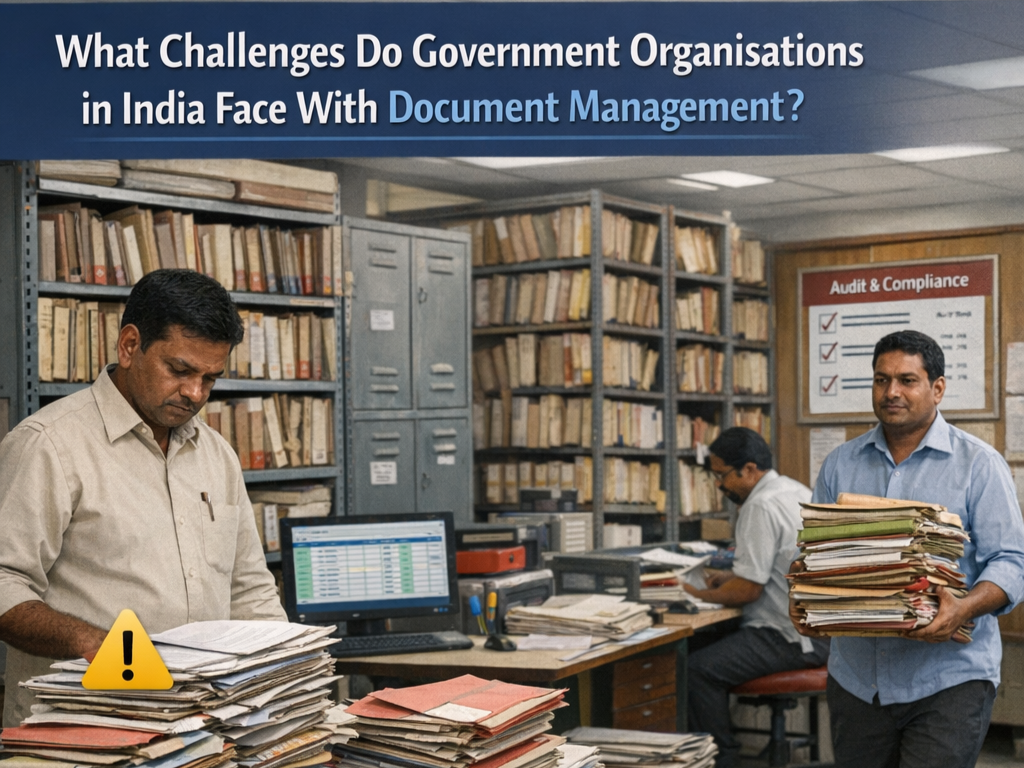
The volume of records that Government departments process over an extended period of time needs to be preserved forever. A structured approach towards records management is required to manage large amounts of records; otherwise, records management will become unmanageable.
Several operational challenges cause this problem:
Large Physical Archives
Many Government Departments have large physical archives of records, which makes it time-consuming and laborious to retrieve records.
Moving Files Manually
Files are sent as a request for approval amongst departments, which takes significant time and adds to the likelihood of a file being lost.
Pressure for Compliance and Audit
Government departments are required to have records available, even if they are audited by the department or regulatory organizations. Therefore, without digital records management, documents that need to be found will be much more difficult to find quickly.
Costs Associated With Physical Infrastructure
Physical document space and document maintenance have a cost associated with storing and maintaining documents in a physical location. As the cost of storage continues to increase, so does the cost associated with having a location to store documents and having to maintain that location.
Limited Visibility of Documents
In a physical filing system, documents cannot be tracked in real-time, and a structured office document management system allows administrators to monitor the movement of documents and to see when approval of documents has occurred.
In short, the problem of storing documents is not as simple as how to store and maintain the documents, but also involves how we can efficiently manage information between these two environments.
Government departments often discover inefficiencies only when records are needed urgently. Assessing your document workflow can help identify areas where a modern enterprise document management system can improve efficiency.
Why Are Traditional Record Systems Failing Public Sector Operations?
The conventional document system is based on physical archives and manual indexing, which can no longer fulfil the increasing administrative demands of state organizations in India. Many of the difficulties listed account for this predicament.
Slow Retrieval of Documents
Manual searching for documents in cabinets and on the shelves is a time-consuming job that takes away from productive administrative time.
Limited Access to Documents
Paper files are not accessible online, which causes major issues for departments that have offices in different geographic locations.
Workflow Automation
There is no document workflow management ability, so approval processes remain entirely manual and are difficult to track.
Document Loss Risk
Traditional paper documents are at risk of being removed and lost in the temporary course of operation between different departments.
Excessive Administrative Personnel
When you store and manage paper documents, you need to ensure you have a sufficient number of staff members, provide multiple document storage locations, and perform ongoing preventative maintenance on your document remote storage devices.
All of the reasons above are why many government agencies across India have already begun looking at document management software solutions.
What Is an Enterprise Document Management System and How Does It Work?

An enterprise document management system is a digital platform designed to store, organize and retrieve organizational documents securely.
It forms the foundation of modern secure record management.
Key Functions of the System:
An updated cloud-based document management system performs multiple core tasks.
- Digitizes paper records
- Organizes files using metadata indexing
- Enables keyword-based search
- Controls user access
- Maintains audit logs
- Supports automated workflows
This means employees can find documents within seconds, and it will be easy for them to search when it’s needed; it’s secure for future use, and they can search manuals through record rooms.
Document Repository Tools
A central digital archive stores records using structured document repository tools. These tools allow departments to maintain organized digital collections.
Workflow Automation
A document workflow management system routes documents between departments automatically, making approvals faster.
Secure Document Storage
A reliable, secure document management system ensures sensitive records remain protected while authorized users can access them easily.
How Document Digitization Services Support Transformation
The process of digitizing documents will allow printed materials to be converted into digitized files and stored in an organized manner. This represents the first step towards digital governance for all government departments in India.
The digitization process involves several different steps.
Pre-Scanning Preparation
The first step toward digitizing documents is preparing the documents for scanning – you need to ensure they are within the framework of an And/or F – it and remove any staples, paperclips, or bindings
Scanning Lots of Pages
Utilize the latest technology for scanning documents and producing a digitized representation of them.
Optical Character Recognition (OCR) Processing
OCR technology enables you to search through your scanned document(s) for text by using an optical character recognizer that extracts textual information from scanned images.
Indexing the Metadata
A representative entry is created for each scanned file, including valuable metadata (e.g., file number, department, date, etc.)
Digital Storage
Securely store your digitized documents in a digital storage system (to help preserve the integrity of the data) for easy retrieval of scanned images and other documents.
By converting today’s static paper archives into digitized records, we are economically enhancing the efficiency of local governments’ administrations.
Large archives can be digitized in phases. A structured approach using professional document digitization services helps ensure records remain secure and searchable.
Benefits of a Cloud-Based Document Management System
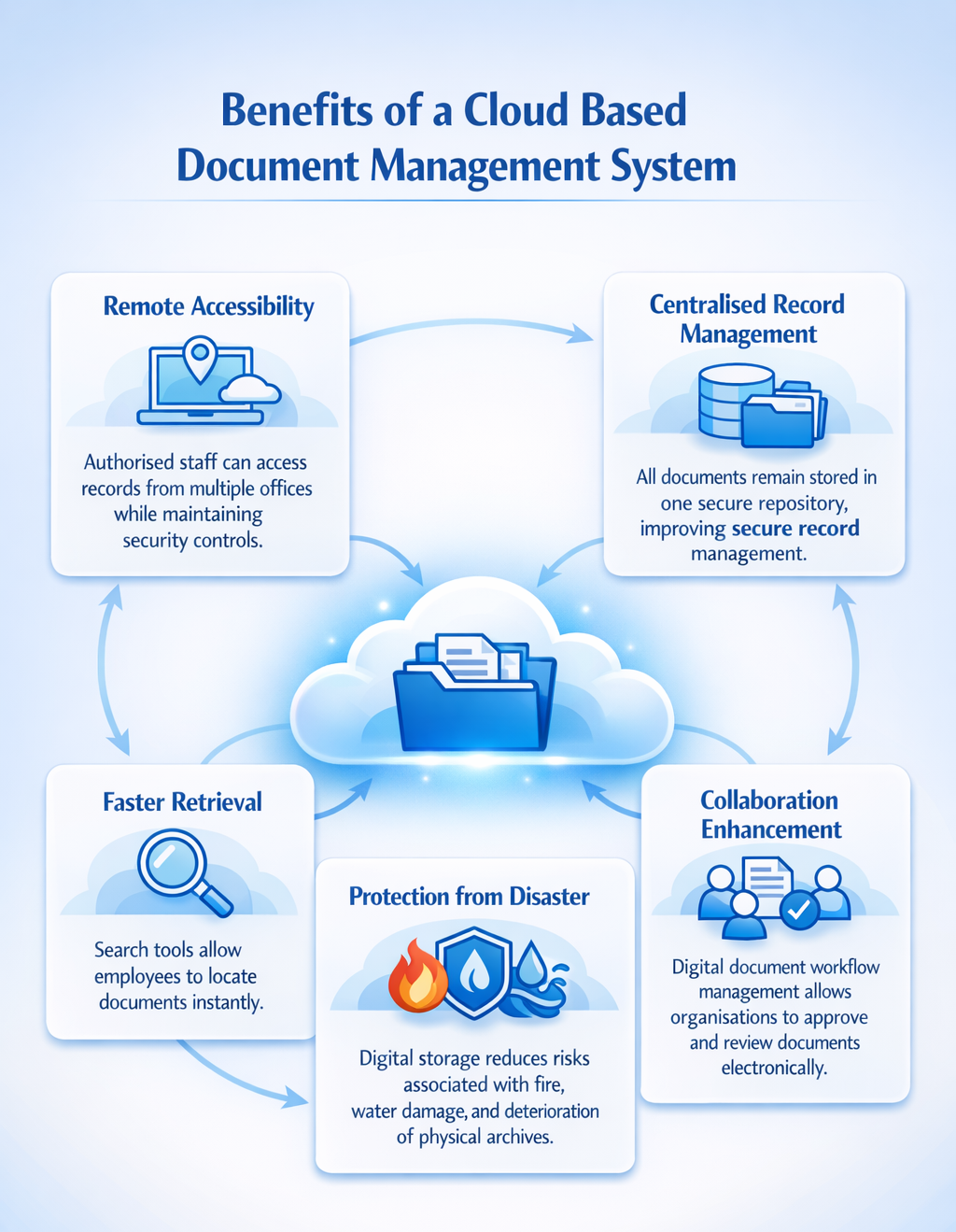
A cloud-based document management system allows government organizations to manage documents securely from a central platform.
Instead of relying on physical storage, departments can access records through controlled digital environments.
Key benefits include:
Remote Accessibility
Authorized staff can access records from multiple offices while maintaining security controls.
Centralized Record Management
All documents remain stored in one secure repository, improving secure record management.
Faster Retrieval
Search tools allow employees to find documents instantly.
Collaboration Enhancement
Digital document workflow management allows organizations to approve and review documents electronically.
Protection from Disaster
Storing documents digitally reduces risks associated with fire, water, and/or deterioration to physical archives.
Government entities that deal with large volumes of documents can benefit from the use of cloud technology as a scalable solution.
Why Are Security and Compliance Critical for Government Records in India?
Government documents often contain sensitive information related to citizens, finances and regulatory matters.
A structured, secure document management system helps protect these records.
Important security capabilities include:
Role-Based Access
Only authorized users can access specific files.
Audit Logs
All document interactions are recorded, supporting compliance monitoring.
Data Protection
A reliable, secure document storage platform protects documents from unauthorized access.
Retention Management
An electronic records management system helps maintain records according to regulatory requirements.
These measures are increasingly important as public services in India continue to digitize.
What Operational Benefits Can Government Departments Expect?
Implementing an enterprise document management system provides several operational advantages.
Cost Reduction
Digitization reduces the need for large physical record rooms.
Faster Document Retrieval
Indexed files allow employees to locate documents instantly.
Improved Productivity
Employees spend less time handling paper files.
Better Workflow Tracking
A document workflow management system helps track approvals and document movement.
Improved Audit Readiness
Departments can produce records quickly through structured, secure digital document storage.
These improvements help government institutions deliver services more efficiently.
Real World Example Government Record Digitization
Consider an Indian municipal property records department.
Problem
There are thousands of files containing land records that are currently stored in physical archives. A request for a historical record generally takes several days for the citizen to receive the record.
Solution
This department uses digitization services and installs a cloud-based document management system to help achieve its goal. All files are scanned, indexed and stored in a secure document management system.
Outcome
Now, employees can get the documents they need in seconds. Citizens will receive improved services because records will be available immediately.
What Should You Look for in a Document Digitization Partner in India?
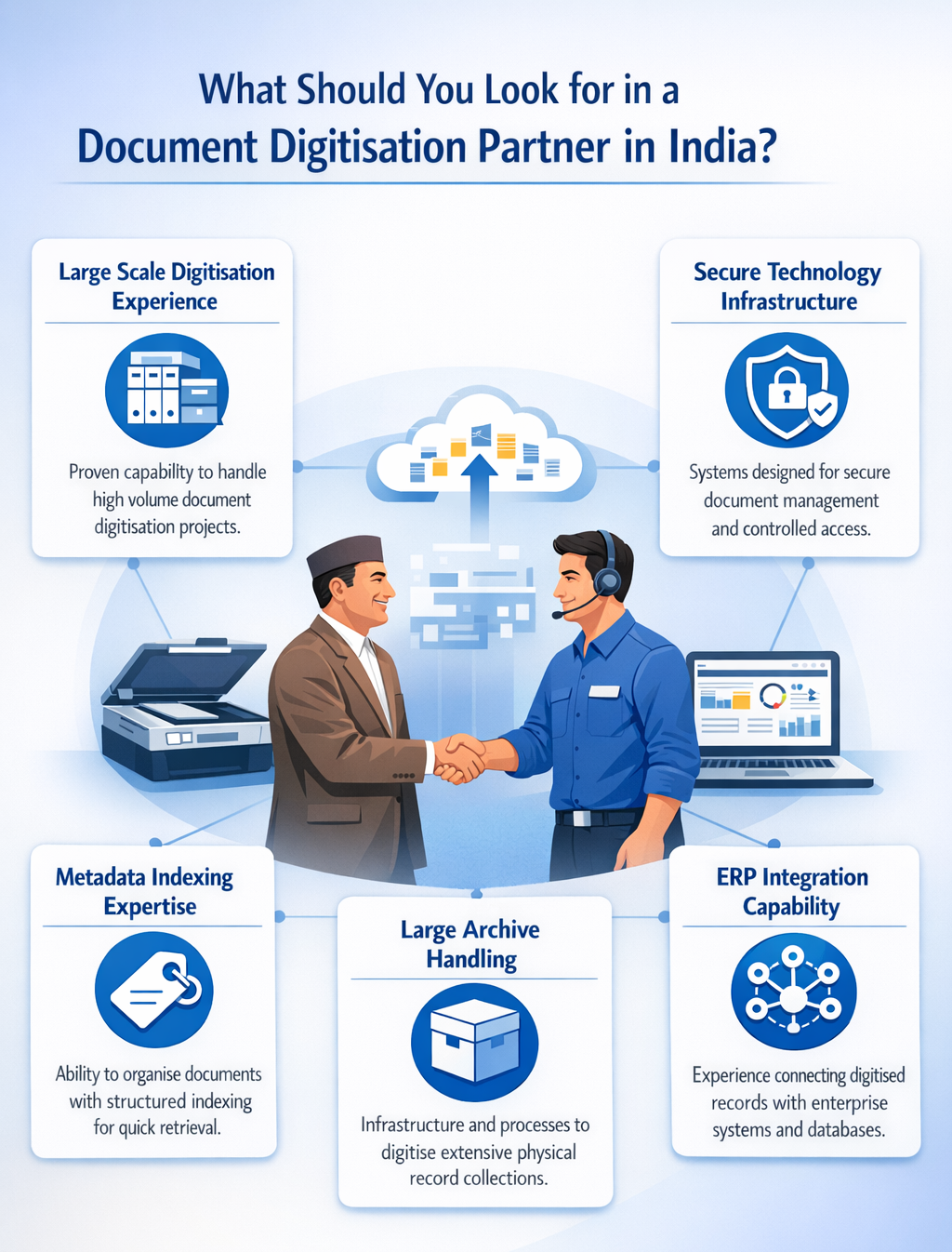
Selecting the right partner is critical for successful digitization projects.
Important evaluation factors include:
- Experience with large-scale document digitization services
- Secure infrastructure for secure document management system implementation
- Metadata indexing expertise
- ERP integration capability
- Ability to manage large archives
A reliable partner ensures the transition to digital records happens smoothly.
Is Your Organization Ready for Paperless Governance?
Many government departments begin digitization when operational challenges become difficult to manage.
Common indicators include:
- Record rooms reaching full capacity
- Increasing compliance audits
- Slow document retrieval
- Rising storage costs
- Difficulty managing multi-location records
When these challenges appear, adopting document management software India solutions becomes a practical next step.
FAQ
What is digitizing documents for Government Departments?
Digitizing documents refers to converting physical records into digital files (for example, converting a paper book into an electronic version). Document digitization allows Government Departments to obtain and manage records more efficiently through their secure digital document storage systems.
How does digitization increase compliance in India?
Digitization increases compliance through structured digital records, audited logs and controlled access to documents. This enables registered audit and/or regulatory review as Government agencies in India can easily locate a previously printed record.
Is scanning on-site secure?
Yes. Document digitization companies will have stringent procedures in place to provide a secure environment for the scanning of documents, and these include controlled access to scanned materials, monitoring of items and secure handling of scanned materials.
How long will digitizing documents take?
The amount of time required depends on the number of records being converted and the indexing needs of each government agency. Large archives may take weeks or months, depending on volume.
What is the Return on Investment (ROI) for document digitization?
The ROI is primarily based on storage savings, improved retrieval of documents, increased employee productivity, and better compliance management through digital records management.