

Introduction
For companies all across India, converting huge volumes of paper-based documents into digital form has become a business necessity rather than a mere option. There are several factors contributing to the urgency behind organizations needing to get their data from paper to discs or other electronic formats. Regulatory compliance pressures, rising costs of storing paper-based data, and paper-based systems hindering operational effectiveness, as well as increasing the risk associated with using paper-based data, are just some of the reasons why organizations need to digitize their paper-based documents today.
Research indicates that organizations can find up to 30% of their time searching for information that has been trapped in paper files. For companies in the fast-growing industries of India, the time wasted searching for paper files can result in delays in decision-making and compliance readiness.
The main issue that companies face in digitizing their paper-based documents is not just scanning documents; rather, it is creating a structured, secure, and scalable digitization process that allows for the support and application of audits, increased access, and reduced operational friction.
This guide will detail the process of how to digitize large volumes of paper documents from beginning to end and provide organizations in India with the considerations they will need to make prior to commencing this process.
What is digitizing large volumes of paper documents?
Converting huge amounts of paper documents into digital formats that can be searched through various methods of converting and managing data is called digitizing large volume files.
Essentially, digitalizing includes scanning or creating an image from special paper files, extracting data, indexing the extracted data, and storing that information in an electronic format so it can be accessed easily and to meet legal requirements.
Why is document digitization important for organizations in India?
Digitalization helps businesses switch from doing things by hand to doing things in a structured, data-driven way.
The main reasons are:
Requirements for following the rules in India
- The price of physical storage is going up.
- Need to get documents faster
- Teams that work from home and are spread out
- Being ready for an audit and being open
A financial services company in India that has to deal with thousands of KYC documents can’t use paper archives for audits, for example. Digitization makes it easy to find things quickly and keep track of them.
What challenges do businesses face with paper-based systems?
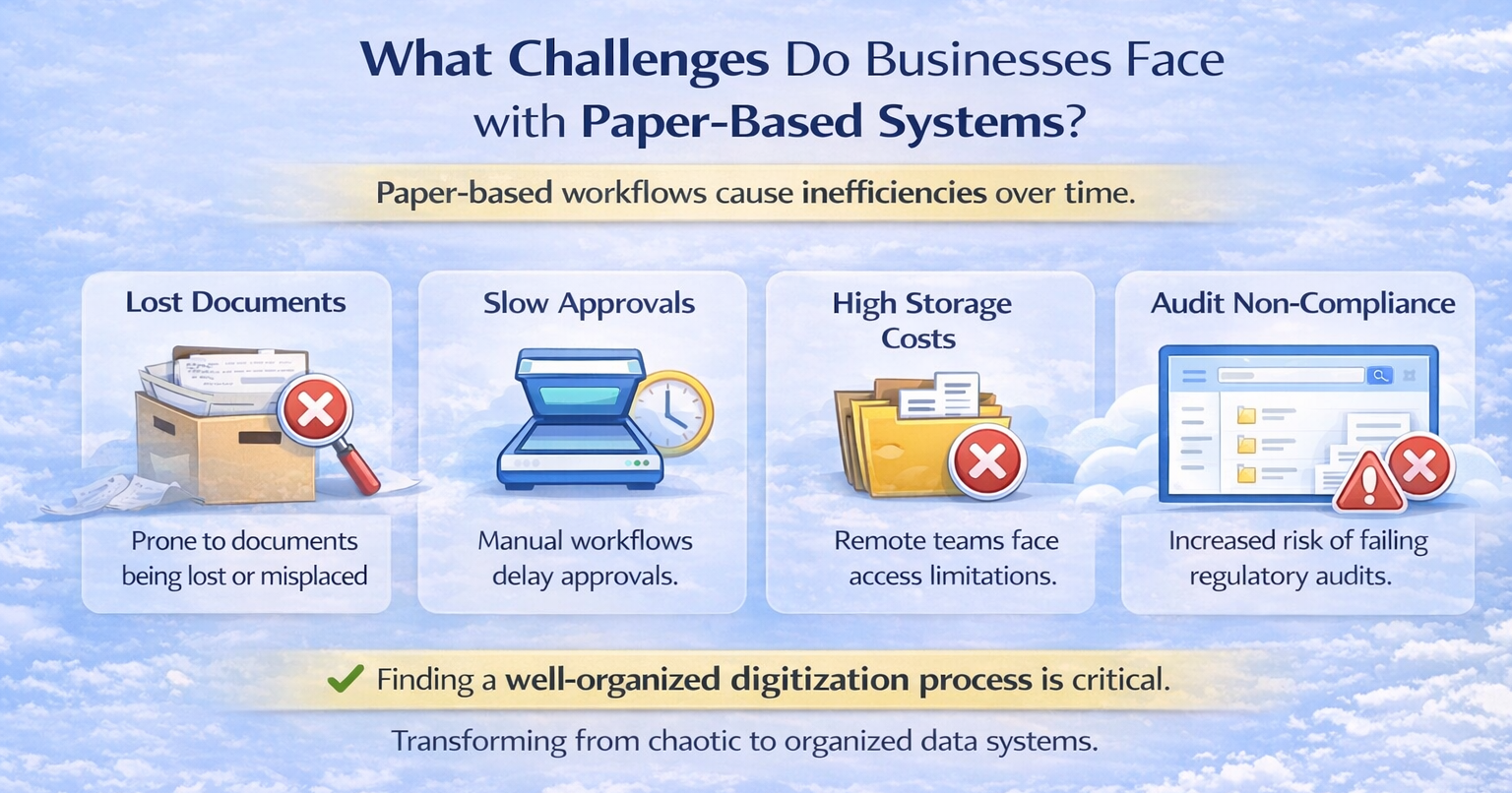
- Paper-based workflows hide inefficiencies that get worse over time.
- Some common problems are:
- Documents that have been lost or misplaced
- Approvals and workflows that take longer
- Costs of storage and upkeep are high.
- Teams have limited access
- Risks of not following the rules during audits
This is where a well-organized process for scanning a lot of documents becomes very important. It replaces disorganized digital systems with organized ones.
What is the step-by-step document digitization process?
The document digitization process follows a systematic workflow to ensure accuracy and efficiency.
Step 1: Document Assessment and Planning
This stage identifies document types, volumes, and priorities.
Key actions include:
- Categorizing records
- Defining retention policies
- Estimating project scope
This helps organizations in India plan resources and timelines effectively.
Step 2: Document Preparation
Physical documents are prepared for scanning.
This includes:
- Removing staples and bindings
- Repairing damaged pages
- Sorting files in logical order
Preparation ensures smoother scanning and reduces errors.
Step 3: Scanning and Image Capture
Documents are scanned using high-speed scanners.
This step converts paper into digital images.
Large-format scanning may be used for drawings, maps, or engineering documents.
Step 4: Data Extraction and Processing
Data is extracted using advanced technologies.
This includes:
- OCR for printed text
- ICR for handwritten content
- AI-based data extraction
This step converts images into usable, searchable data.
Step 5: Indexing and Metadata Tagging
Documents are organised using metadata.
This means assigning tags such as:
- Document type
- Date
- Department
- Reference number
A strong document scanning and indexing workflow ensures quick retrieval later.
Step 6: Quality Check and Validation
Accuracy is verified through multiple checks.
This includes:
- Image clarity review
- Data accuracy validation
- Error correction
Quality control is critical for compliance and usability.
Step 7: Storage and Integration
digitized documents are stored in a secure system.
This may include:
- Cloud-based DMS
- ERP integration
- Access control systems
This step ensures documents are accessible and secure.
Step 8: Secure Disposal or Archiving
After digitization, documents may be:
- Archived securely
- Retained as per compliance rules
- Destroyed following protocols
This completes the lifecycle.
Planning to digitize legacy records across departments?
Start with a structured audit of your document volumes and workflows to avoid delays later.
How does document preparation impact digitization quality?
Document preparation directly affects scanning accuracy and speed.
Poor preparation can lead to:
- Skewed images
- Missing pages
- Data extraction errors
In simple terms, better preparation means fewer errors and faster processing.
For organizations handling sensitive records in India, this step reduces rework and improves efficiency.
What kinds of technology are used to digitize a lot of documents at once?
Modern methods of digitizing large amounts of documents use cutting-edge technology.
Some important parts of technology are:
- OCR (Optical Character Recognition) for recognising text
- ICR (Intelligent Character Recognition) for reading handwriting.
- OMR (Optical Mark Recognition) for reading forms
- Getting data from AI
- Document management systems that work in the cloud
- Audit logs that keep track of who accesses digital documents
All of these tools let you scan in static documents and make a structured data record. For instance, big Indian insurance companies use AI extraction to quickly process claims.
Looking to automate data extraction from documents?
Explore AI-powered OCR solutions for greater accuracy and scalability.
How does the document scanning and indexing process work?
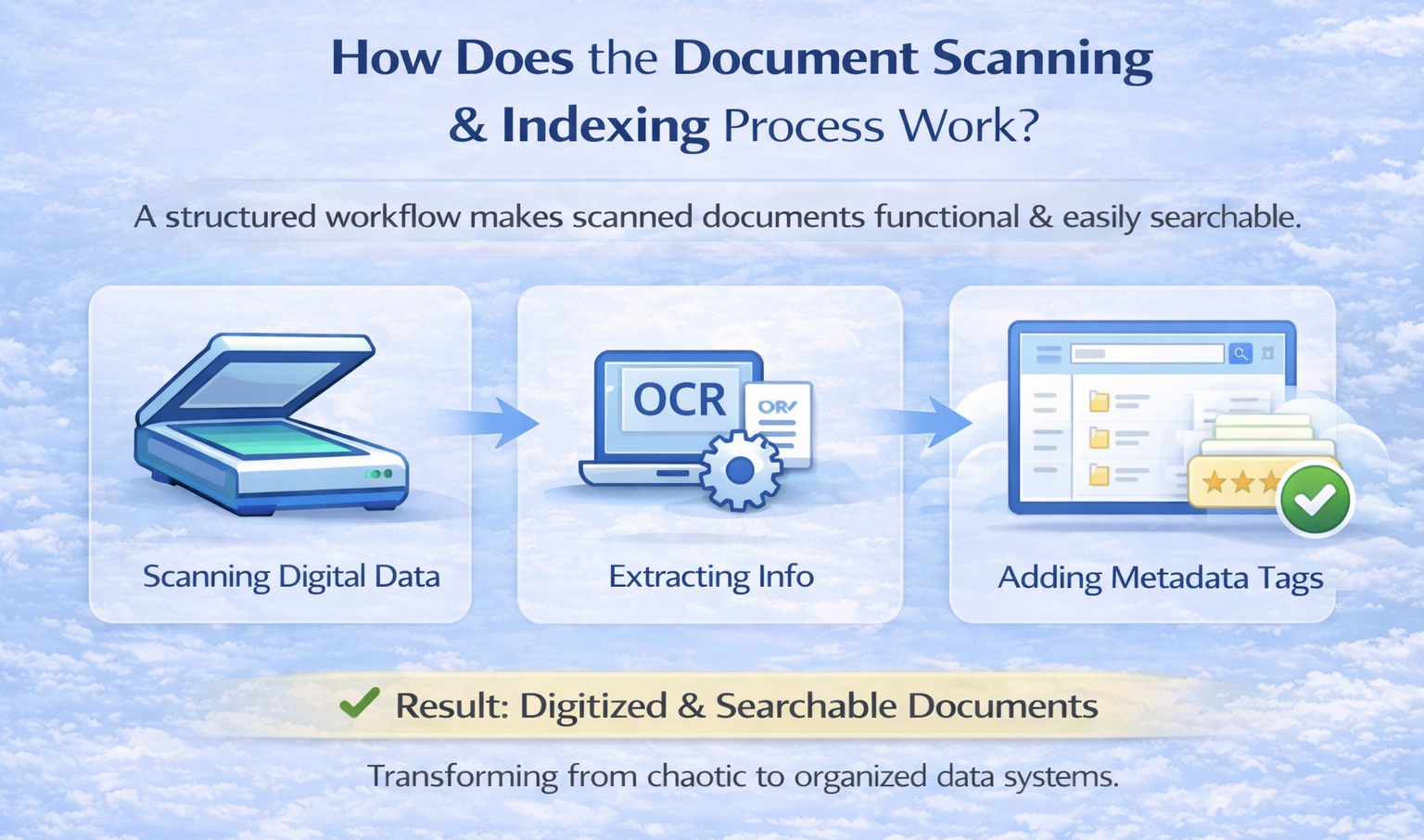
A Document Scanning & Indexing workflow provides functionality to digitized documents.
This workflow includes three components:
- Scanning documents as digital data
- Extracting important information from those documents
- Adding metadata tags (e.g., keywords) to identify those documents.
The result is that users can search/locate digitized documents immediately. Without indexing, effectively becoming digital repositories, will not create functional systems.
What compliance and security measures are required in India?
Compliance is a major driver for digitization in India.
organizations must follow:
- Data protection guidelines
- Industry-specific regulations
- Audit and retention policies
Security measures include:
- Role-based access control
- Encryption
- Audit trails
- Secure storage
For sectors like healthcare, legal, and finance, compliance is not optional.
Digitization helps maintain structured records that are audit-ready.
Concerned about compliance and data security?
What is the cost and ROI of digitizing large volumes?
The cost depends on:
- Volume of documents
- Complexity of data extraction
- Storage and integration needs
However, the ROI is measurable.
Key benefits include:
- Reduced storage costs
- Faster document retrieval
- Improved productivity
- Lower compliance risks
In simple terms, digitization shifts costs from physical infrastructure to scalable digital systems.
When should organizations start digitization?
The right time is usually triggered by:
- Regulatory changes
- Business expansion
- Rising storage costs
- Frequent audits
- Transition to digital workflows
In India, many organizations start digitization when audits become difficult to manage with paper records.
Starting early avoids last-minute pressure.
How to choose the right digitization partner in India?
Selecting the right partner is critical for success.
Look for:
- Experience in your industry
- End-to-end capabilities
- Strong compliance framework
- Scalable technology stack
- Integration with existing systems
A capable partner ensures smooth execution of the bulk document scanning process without disrupting operations.
Evaluating a digitization partner?
Focus on process clarity, compliance capability, and scalability, not just cost.
Frequently Asked Questions
What is Enterprise Document digitization?
Enterprise document digitization refers to the conversion of paper documents (including records) into electronic files, so they can be easily stored, managed, and accessed. The main advantages of document digitization are improved efficiency and reduced dependence on paper records.
How digitization Enhances Compliance in India?
Compliance is made easier through digitization. When records are digitized and stored digitally, they can be readily sorted and accessed, making it much Easier for an organization to demonstrate compliance with regulatory requirements. In India, digitized records are how organizations will be able to produce records in response to requests for audits as required by government authorities.
Is Onsite Scanning Secure?
On-site scanning is a secure process as long as proper protocols are followed (e.g., secure physical access, monitoring of workflow processes, and encryption of data during the scanning process).
How Long Does Digitization Take?
The length of time it takes to digitize a document depends on several factors, including the number of documents, the complexity of the process and the design of the workflow. For large projects in India, the timeframe can range from 1 week to several months, depending on the size of the project.
What Is the ROI of Document Digitization?
The ROI from document digitization will be derived primarily from reduced costs for storage, faster availability of data, increased productivity and decreased compliance risk. Over time, the ROI from a digital storage solution should be less expensive than a solution that relies on physical records.
Final Thoughts
digitizing large volumes of documents is not just about scanning paper. It is about building a structured system that supports growth, compliance, and efficiency.
For organizations in India, the shift from paper to digital is a strategic move. Those who invest in the right document digitization process today will be better prepared for tomorrow’s demands.